Legal
Contact
Christian-Liebig-Stiftung e.V.
Frundsbergstraße 23
80634 München
info@christian-liebig-stiftung.de
Donation account
Christian-Liebig-Stiftung e.V.
IBAN: DE20 700 700 240 7003700 00
BIC: DEUTDEDBMUC
Deutsche Bank München
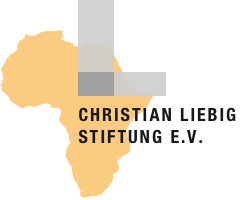
Matthias Scharpf (23) is the youngest member of the board of the Christian-Liebig-Stiftung e.V.. After volunteering in Malawi and whilst studying International Relations and Management at OTH Regensburg, he has been volunteering as a board member for the CLS since spring 2026. Here he explains how it all began and why Malawi continues to hold a special place in his heart.
Matthias, how did you first come across Malawi?
It was 2022. After completing my advanced technical certificate, I went to Malawi as a Weltwärts volunteer through the children’s mission organisation “Die Sternsinger”. I lived in the parish of Benga in the Nkhotakota district for eleven months and worked on a project supporting the elderly. We delivered food and everyday essentials to the villages – sometimes right on the shores of Lake Malawi, sometimes in remote mountain villages. The parish alone covers over 3000 square kilometres, bigger than Saarland. That really brought the incredible diversity of the country and its people to life for me.
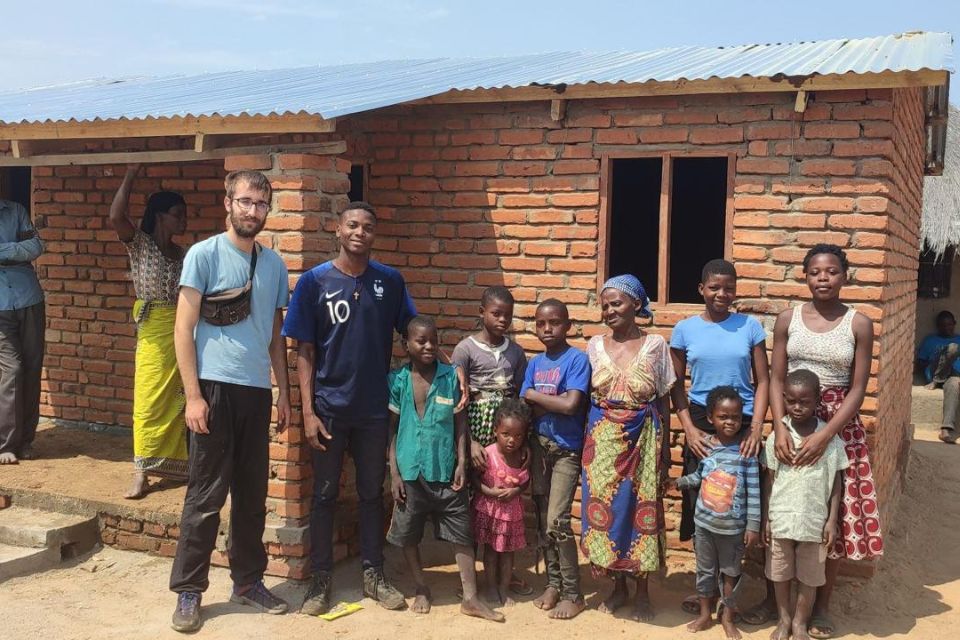
Matthias Scharpf in Malawi.
You were 19 at the time. What was that like for you?
It was the first time I’d flown to another continent. And to be honest, the first two months were hard. The cultural contrast, the difference in living standards – at first, I wasn’t sure if I’d really manage to complete the placement. Until a moment that actually sounds quite unremarkable: a colleague from my project invited me to a nsima meal in his village. We sat outside the house, ate together, the sun went down, people gathered, and for the first time I felt at home, 10,000 kilometres from home. That feeling stayed with me throughout my entire time there and has stayed with me to this day.
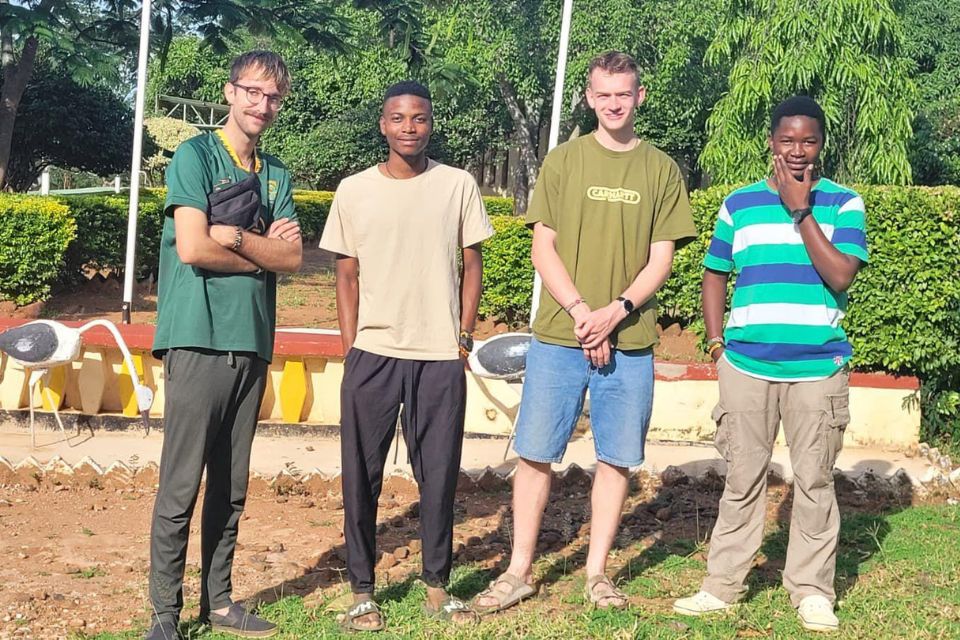
Matthias Scharpf has been making a contribution in Malawi for years.
And then the Christian-Liebig-Stiftung came into the picture?
Not immediately. Once back in Germany, I started networking through the German-Malawian Society, church structures and personal contacts in development cooperation between Germany and Malawi. I naturally came across the CLS, as the foundation has been a key player in this field since 2003 thanks to its projects. I got in touch with the office, and this led to a regular correspondence with Beatrice and other board members, which was always on an equal footing. At some point, I felt that whenever there were interesting contacts or news from Malawi, it was best to give the CLS a call.
What led to the offer to join the board?
It came as a real surprise. I was in Malawi for my work placement from October 2025 to February 2026, working for the social services arm of the Archdiocese of Lilongwe. The day after I got back to Germany, I met up with Beatrice and Ute in Munich, and they offered me a place on the board. I was completely blown away because I hadn’t expected it. But I knew straight away: even if I slept on it first, that I’d say yes. So I did.
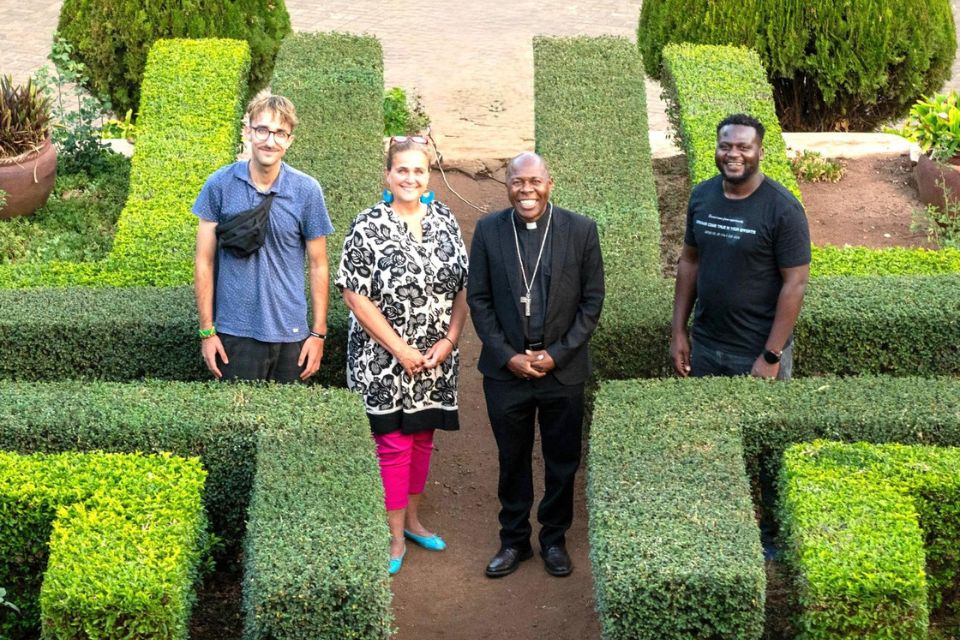
Matthias Scharpf and Beatrice von Keyserlingk are discussing a project on site.
What are your plans for your new role?
Above all, I want to help strengthen existing partnerships – like with the Benga parish, where I was a volunteer. I’m also committed to fostering new collaborations, in the areas of girls’ health and women’s rights, for example. There are concrete initiatives here, such as distributing sanitary products directly to schools to make it easier for girls to attend school. I am also contributing with my network, which includes church partners, other organisations and numerous individuals in Malawi who are doing excellent work there.
What fascinates you about the work of CLS?
That it isn’t doing the kind of stereotypical development aid. No saviour complex, no ‘we’ll build a school and then forgot about it’. CLS goes there, talks to the people, works out a plan together with them, and then ensures that the project is sustainably supported in the long term. That’s the right way. Development aid is, after all, a field that aims to make itself redundant, because at some point it should be a partnership on equal terms and no longer a one-way street.
And personally, the fact that Beatrice and the friends and family of Christian Liebig have managed to turn something as terrible as the loss of a loved one into something so good for thousands of people in Malawi is very moving. It sends a powerful message – especially at a time when international cooperation is often becoming less valued. touches me personally: Beatrice and the friends and family of Christian Liebig have managed to turn something as terrible as the loss of a loved one into something so good for thousands of people in Malawi. That is a powerful sign – especially at a time when international cooperation is often losing its value.
This is an important point. Some people say: “We have enough problems of our own in Germany.” How do you respond to that?
We live in a globalised world. The problems there will have consequences for us at some point – whether through climate change, migration or the loss of partnerships. We would rather focus on cooperation together than pretend that none of this is any of our concern. Some people are more easily reached through an appeal to humanity, others through the argument that cooperation is ultimately in our own interests. Both are true.
Final question: What do you say to people who think, “My small contribution won’t make any difference”?
I like to answer that with a quote from one of my favourite films, Cloud Atlas: someone tells the main character that what they’re doing is just a single drop in a limitless ocean. And the main character replies: “Yet what is any ocean, but a multitude of drops?”. It might sound romantic, but there’s some truth in it. You might not be able to build a school on your own, but when hundreds, thousands of people contribute – as donors, as members, as volunteers – then it becomes something great. And that is exactly what CLS is: a community made up of many small contributions that, together, make a big difference.
Photos: Matthias Scharpf, Affonso Gavinha